Some recent writing by the Scribes Group
Permanence and Immutability
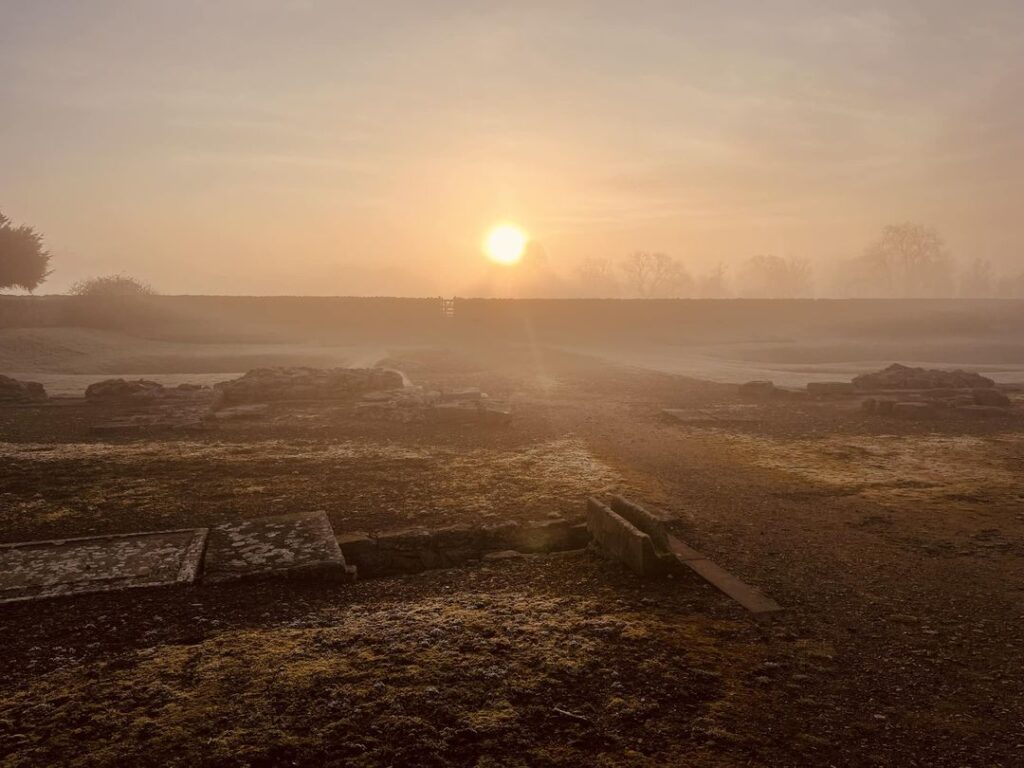
The colours in the sky a gentle gradation of pinks, oranges and mauves, surrounding the fading sun low down on the horizon which glimmers dimly in the distance. The round orb shrouded by dust from the atmosphere, its outline smudged and softened. Once it shone on untouched, rough, forested land. Man came, used the trees and the land, made it theirs.
But not for long. Nothing stays the same. The land and the sun are permanent and immutable.
100 AD Roman soldiers came to the north of Britain and built their forts and temples, baths and shops and towns. They chopped the trees down, dug up the ground, changed everything, following their tried and tested, well researched plans which had been used by Roman conquerors all over the Empire.
Local tribes either accepted the Roman laws and regulations or were annihilated. No room for pity or negotiation! Modern day financiers and moguls would have felt very at home.
And where the soldiers lived and worked, civilians followed to trade and make a living. That place was a hive of commerce, activity and life.
But not for long. Nothing stays the same. The land and the sun are permanent and immutable.
Now the sun shines on the ruins of an Empire. Now nearly two millennia later the remains of this outpost lies shrouded in mist and mystery.
Buildings gone, people gone, only echoes on the ground. Generations of people, generations of hopes and ambitions all hang suspended in that mist of time.
Now just the land and the sun, permanent and immutable.
Food for the Soul
Food for the soul…Comfort food at its comforting best.
Over the years I've amassed quite a library of cookery books… Delia, Nigella, Jamie Oliver, Gary Rhodes, Mary Berry to name just a few but none of their offerings can compare to the recipes on scrappy pieces of paper, scribbled down from memory, that as hard as you try, you can never quite replicate. Here are some of them, starting with my maternal grandmother, Granny Auton and her stew.
Granny Auton's stew was started on a Monday to be ready on Wednesday and was in quantity, sufficient to feed Catterick Garrison but that was how she cooked. Half a crown's worth of "pie meat" from Monroe's butcher's shop, plus a handful of this, a pound of that, barley, split peas, every available root vegetable, some gravy salt, pepper and gravy browning to simmer away in the copper, heated by a little coal fire beneath it in her ancient kitchen. It was wonderful, I can close my eyes and still taste it!
We all lived within 50 yards of one another…aunties, uncles, cousins and there was a bowl for everyone of us. The secret died with her… we all knew what went in it, but we didn't have her touch. It's just a warm memory… like her Yorkshire puds, made in the oven of her black-leaded range with self-raising flour. Don't ask me how they rose but they did. They came before the meat and veg with Yorkshire Salad…shredded lettuce, thinly sliced onion, cucumber, chopped fresh mint, malt vinegar with a little sugar dissolved in a splash of boiling water, all mixed in a little glass dish, sometimes with sliced hard-boiled egg on the top but only if it was with meat left over from the Sunday roast…mmmm!!
Now for my paternal gran's speciality… Grandma Dixon's Shepherd's Pie, though being made with corned beef, the purists would deny it the title of Shepherd's Pie as there was no lamb in it. A tin of corned beef cubed, a tin of diced mixed veg, a small tin of Heinz Scotch Broth all topped with lots of buttery mash and baked until its forked furrows were golden brown…wonderful! It fed four hungry grandchildren every Saturday. She once asked if we'd rather have something else for a change… definitely not was the unanimous verdict.
My mother was a reluctant cook, preferring to leave cooking to my dad who was a star! However when she did cook her corned beef pie was perfect…potatoes and onions boiled together, then chopped up rather than mashed, with pepper and made into a plate pie, served with homemade chips and mushy peas for Thursday tea, always a Thursday, don't know why. Mam's panhageldie was a family favourite…sliced corned beef from the Co-op layered with chopped up tinned tomatoes, then thinly sliced potato and repeated again with a little Oxo stock poured over, covered with a lid and cooked until the top potato layer was soft. The lid was left off and the dish put back into the oven for the potatoes to brown. Mam always served Yorkshire puds with it…didn't we eat a lot of corned beef?!
As I've said, Dad could cook. He could gut fish, dress crabs (mind the Dead Men's Fingers!), make a mean hot water crust raised pie… the list is endless. He was a widower for 24 years until he died and right up till his final year, he still cooked all his own meals. He made my wedding cakes for my first wedding, and they were perfect, but my special memory has to be something as simple as chips, yes chips. Money was always tight in our house and sometimes even a suppertime bag of chips from the chip shop at the bottom of our street was out of the question. His "bait" for work was always put in a greaseproof paper bag then put in his bait tin. When there was no money for chips, he'd make some and even make batter for scraps and put them in his sandwich bags and wrap them in newspaper! A shake of salt and vinegar and they were better than from Rafferty's chip shop down the road!
Lena, my mother-in-law, was always baking…church coffee mornings and bake sales or just to make sure the biscuit and cake tins in the pantry were never empty… chocolate bottom cake, millionaire's shortcake, Eccles cakes and Belgian cake are some of my favourites. She even perfected a gluten free cherry cake for her son-in-law Allan who was gluten intolerant. Belgian cake was a cut and come again loaf cake, all measured out in cups, apart from the butter. Milk, butter, dried fruit, sugar were all heated together in a pan before adding an egg and some bicarbonate of soda in a little milk, before sifting in self-raising flour. It was all the better for keeping a few days before cutting it and eating it as it was or spread with butter.
My late sister-in-law Margaret's flapjack was to die for! There was no written recipe… it was a handful of coconut, golden syrup, butter, a handful of oats, Demerara sugar, glace cherries, raisins and a little almond essence. It was baked until it was ready and never the same
twice but delicious every time.
Finally, Cheese Dreams must have a mention…given to me by an old man who drank in the pub where I worked during the summer holidays. A simple cheese and onion sandwich, both sides of the bread buttered and fried in a frying pan on both sides till brown…ecstasy but not much good if you're watching your cholesterol. I think Elvis ate something like that and look where it got him! I've even had one for breakfast before now!
Road Trip
Although they are cumbersome and sometimes difficult to read in a moving vehicle, these days I prefer a traditional paper map. A map is an honest and trustworthy tool that will have all the information needed when a full bladder or an empty stomach threaten to interfere with your travelling pleasure. I prefer one now to Google Maps. Google Maps is great, it uses satellite imagery, aerial photography, street maps, and 360° panoramic views of streets to provide up-to-date, digital maps for route planning and travel. It’s magic and we loved it. Some years ago we were in the USA and, not having sat nav in the car, Google Maps had served us well for many hundreds of miles. We were presently travelling on Interstate 20 from Boise, Idaho to Victor in Teton County from where we were intending to explore the Grande Tetons and Yellowstone Park. Things were getting a bit fraught. If we didn’t find a toilet and some food soon I’d explode. We’d been travelling for hours without finding either of these comforts. “We have to stop!” I shrieked at my husband Bob, suddenly.
He jerked. “For God’s sake, why are you screaming like that?” he snarled at me. “Because I’m bloody desperate.” I screamed back.
“Well there must be somewhere to stop,” he said, “look properly at the map.” I took a deep breath. “I am bloody looking properly. There’s bloody nothing between here and a place called Carey and that’s another 45 bloody miles!” Bob made no comment. I told myself to calm down, a marital barney wouldn’t help. I studied the screen closely but despite desperate zooming in and scrolling ahead, could see no side roads, habitations or any physical features at all. The road, on the map and through the windscreen rolled on smoothly, relentlessly empty. “You must stop at the least sign of a side road or track, or I won’t be responsible for the state of this car!” I screamed, all semblance of calm evaporating. “Stop bloody screaming woman,” he yelled frantically, “there aren’t any side roads!”
A tense silence descended. We’d both screamed enough. I stared out of the window. “Stop!” I shouted suddenly. He tensed but didn’t stop. “Stop!” I yelled again, “there’s a track back there, on the left.” Without a word he stopped the car, turned around and drove slowly back until I said “Look, just there. Turn in and drive down a little way please.” He did so silently.
The interstate became a gravelled track, dusty and dry, with emptiness on either side. Bob was obviously preparing to turn back when I spotted a little wooden sign up ahead. As we got closer, we saw the single word “Gas” burnt into the wood. “Thank God.” I murmured.
We pulled into the deserted car park, scrambled out and hurried to the door praying for the place to be open. Surprisingly the shabby front door opened into a clean bright hallway and no map was needed to find the Ladies on the left and the Gents on the right. We met up after a few private minutes and went through a set of double doors straight ahead. We were once again taken by surprise, to find ourselves in a large general store filled with snacks and drinks, grocery essentials, household products. We cheered up at the sight of a Grill counter with an open kitchen at the back of the building. We perused the menu quickly and I wandered away to explore the store,
leaving Bob to order food. I found rustic tables, fashioned from huge old beer barrels, with horseshoes and cattle brands on top, a unit displayed every kind of gear for outdoor living, a huge display of fishing flies and rods with (Ugh) supplies of worms and maggots on the
table below. In the middle of the space was a display of old fashioned looking clothing next to a selection of dated household textiles. I was delighted to discover a stall of old books and ancient looking maps. I was about to explore these to compare them to the Google Map of the area, when I noticed two men chatting in the far corner.
As I wandered over, I could hear them. “How’s it going Ernie?’ the tall man standing up was saying. The other man, who looked vaguely familiar, although I knew I could never have met him, looked up from where he sat at the old wooden desk and drawled “Oh, you know how it is Bud. Some days slower than others. Got a couple a good-sized trout this mornin’ and just a couple a good sized paragraphs this
afternoon.”“Ah a writer.” I thought, moving closer to listen in. I’m unashamedly nosey about other people’s conversations, especially if they’re talking about books. On the desk a cluttered collection of paper, ink, old fashioned pens and pencils almost covered an old local newspaper, the “Idaho Life”. “What’s it about?” his friend asked. “You ever been to Spain Bud?” replied his friend gruffly. “I reckon it’s the last good country left. Sun Valley around here reminds me of the Spanish countryside. Book’s about bull fighting in Spain” “What you gonna call it Ernie?” Guy asked. “Mmm… dunno, still thinkin.” his friend replied musingly.
“It sounds like Death In the Afternoon, but that’s been done.” I muttered, then felt myself blushing as I realised I had said it out loud. Both men jerked around to look at me. “Well howdy there, miss, you visitin’ these parts?” asked Bud, in a friendly way. His friend simply stared at me darkly. “Just passing through,” I replied. “We didn’t see this place on the map, it was just luck that we saw the turning.” “Yeh, we like to keep the place pretty private, don’t like to be disturbed by tourists and busybodies.” the man at the desk growled.
Blessedly, at that moment Bob called to me from one of the barrel tables, “Come on Marg, grub’s up!” I moved away in relief, nodding politely at the men. After we’d eaten, we left the store, got back onto the S20 and continued our journey amicably, I all the while wondering why the burly man looked so familiar and why he obviously wasn’t keen on strangers. Or was it just me he didn’t like? I had after all rudely interrupted their conversation, hadn’t I?
A week or so later we were on our return journey from Victor to Boise, about 25 miles past Carey. Although we didn’t need directions, I reached for my phone and clicked on Google maps. I had been musing for days, in between enjoying the splendours of The Grand Tetons and Yellowstone Park, on the gas station where we had stopped, and wondering why there had been no markings of any kind on Google Maps for at least thirty miles either side of it. To my surprise I now saw on the screen several roads leading off both sides of Highway 20, all with suitably Western names like “Cut-Off Road”, “Dry Creek” and “Ranch Road”. A few miles ahead I could see a place labelled Chevron Petrol Station, and close beside it Silver Creek Convenience Store. Both were in a place called Picaboo. Delighted by the name of the town I suggested we had coffee there and twenty minutes later we pulled into the forecourt of the station. The long wooden store
behind it looked very familiar. “Isn’t that the store where we stopped on the way over Bob?” I asked, “But in a different place?”
“Looks like it. Lets go see.” he replied.
Inside we were amazed to see it actually was the old gas station we’d been in but somehow colourfully different. The content seemed the same but all more modern, the lighting was brighter, the walls were freshly painted, it was air-conditioned and Dolly Parton was streaming gently in the background. We were served two large cappuccinos by a cheery, gum chewing teenager with pink hair who chatted away while she made the drinks. “Has this place been here long?” I asked her. “Oh, just about forever,” she laughed, “according to my granddad” Leaving Bob to collect the coffees and pay, I wandered once again over to the far corner where I had encountered the two men last time we were here. There was a small bookcase now containing a collection of hardbacks and the walls were covered in photographs and newspaper cuttings. In a large central article the word Papa jumped out at me above a photo of Ernest Hemingway. I knew immediately why the brusque man had looked familiar. But that was impossible! I know that Hemingway died in 1961. The walls were covered with memorabilia about Hemingway’s life in the area, his home in Kechum, north of Picaboo, the friends, including Bud Purdy, he went hunting and fishing with in Silver Creek and the books he wrote here. It was fascinating and it would have been such a pleasure to have discovered this lovely little museum here in the middle of nowhere were it not for the fact that I knew I’d
seen the man in the these photographs just over a week ago, in this very building. How could that possibly be?
I thought about what I knew to be real. I knew that my phone, fully charged, had shown no physical features of any kind, apart from the road, on the Google Map between Fairfield and Carey on our outward journey. I knew that the date on the old “Idaho Life” newspaper was Friday 13th May1931. And I knew that Hemingway had published “Death In The Afternoon” in 1932. So, was I hallucinating on that first visit to Pikaboo? I’ve read that low blood sugar levels can do that, make you hallucinate, but I hadn’t been that hungry surely.
Did I dream the whole episode? Impossible, unless Bob had the very same dream. Did Google Maps take us back in time? Equally impossible. Did Google Maps take us to a parallel universe? Totally and utterly impossible!
I couldn’t either then or since, come up with any logical explanation and hours spent on the internet have not enlightened me. In the ongoing pursuit of marital harmony I don’t speak about this incident very often. It continues to haunt me though, not in a bad way, but I puzzle over it in quiet moments and search for an explanation. Bob makes light of it, he doesn’t understand why it bothers me.
He suggests I dreamt the first encounter and should simply forget it. He does however feel that the use of a paper map whilst travelling contributes to a certain amount of disharmony these days and would be far happier if I stuck to Google Maps
The Woollen Shawl
It had been her great grandmother’s and it had never been used since her aunt disappeared into the deep dark forest, never to be seen again. Her grandfather and father had found the shawl draped over a bush beside the path that led into the woods. It had been retrieved and kept in case Aunty returned as it was their only memory of her.
The long, thick dense blood red shawl hung on a hook behind the bedroom door. It was hidden behind other coats and blankets, but every time Harriet opened the door and looked behind it, the shawl seemed to move and shimmer. She was fascinated by the different textures of the shawl. It had been woven by Grandmother and the other older women in the village, made from the same coarse thick wool that everyone’s clothes were made of. But somehow the shawl seemed lighter, more floaty, almost shimmering.
Of course, she was forbidden to touch it, certainly not allowed to wear it. But that’s the point about forbidden things, the temptation, the ongoing encouragement. ‘Come and stroke me, I’m so soft, just a little touch.’ And of course, that’s just what Harriet did. She gently lifted the other coats aside and stroked the shawl. Her hands were drawn into the soft thistledown and the deep rich crimson covered her hands and arms. She could hear a whispering and murmuring; “take me down, put me round your shoulders.” And she did.
Something familiar overwhelmed her, the warmth and comfort were what she expected; but the urge to go outside, into the woods suddenly pushed her into action. Boots were slipped on, and she was out, running along the path. She’d never been along there before, but she knew the way. She was running and laughing, waving her arms.
He was waiting, she knew him at once. The dark black dense fur, those pointed alert ears, those eyes that drilled into her. She wasn’t frightened, after all she had come to meet him. In her excitement, she pirouetted round arms above her head and the shawl drifted from her shoulders billowing in the wind gently blowing along the path and settling on a bush near the edge of the wood.
While Harriet, ran laughing and skipping towards her dark desires.
Little Red Riding Hood
I make sure that everybody sees me, dressed demurely in my little red cloak with the hood pulled up covering my hair. It’s easy to fool them; I always nod as they see me, eyes down, oozing respectability. I follow the same path through the thick, overgrown undergrowth, I can feel them watching and checking, but that’s exactly what I want them to do. Invisible by being highly visible, that’s the plan.
Of course, what they don’t know is, what’s in my basket. I chose the open basket particularly; it’s semi open and I carefully place the little wrapped packages on the top. I take time wrapping the packages in gingham material with matching ribbon tied in stylish bows. I don’t actually tell people what’s in the parcels, no need to lie when you don’t have to; they make their own assumptions. Me, going through the deep, dark woods to see my ancient granny carrying a basket; what else could it be?
I mean it’s not as though I’m carrying anything dangerous or awful in my basket, though they would think that if they lifted up the pretty parcels. I’m just returning books. Books? I mean how can they be dangerous? But to them they are. Especially as I’m a girl and not supposed to read books; apart from those that tell me how to look pretty and cook nice cakes and keep my future husband happy! I ask you! Society doesn’t approve of girls who ask questions.
It's the wolf’s fault. He teamed up with Granny and started sending away for books about Science and the Universe. I mean being a wolf and all, he’s very aware of the patterns of nature and the phases of the moon and stars, and well he just wanted to find out more. Granny couldn’t help herself, once Wolfie had started discussing the patterns of the stars, she was hooked. She tried to keep it quiet, but she’s rubbish at keeping things secret, and she blabbed it out to me during one of my visits when I actually was taking her some cake and checking on how she was. I was intrigued, and she encouraged Wolfie to join us for tea, and when he started talking stars, planets universes and I looked into his deep, dark eyes I was hooked.
He’s kind of like Brian Cox only hairier! That same ability to talk about the most amazingly complicated aspects of space and science and make it seem effortlessly easy. That was the problem, I couldn’t remember everything he said so he organised the books, Granny rdered them from the dark web and I was allowed to take them home, one at a time, hidden under Granny’s fancy food packages.
Of course, there’s no happy ending. I can’t live with Wolfie, I mean his table manners are disgusting, you should see what he does to a cream cake! And Granny, well she’s getting on. So, for the moment, we’re carrying on, as not to arouse suspicion, but I’m planning the escape. I’m building up the wardrobe and documentation that I’ll need ready for University; and Wolfie has promised to escort me through the woods to the other side. He knows all the hidden routes that the hunters have never found.
Meanwhile, I put on my red cloak and hood to cover my body and my thoughts and return home with the next volume of Particle Physics to enjoy.
The Picture
George Dobson was contemplating yet another change of hobby, much to the exasperation of Jennifer, his long-suffering wife for almost thirty-nine years. The shed, loft, garage and study were littered with the paraphernalia of several discarded hobbies, all begun with great enthusiasm and often a considerable outlay of cash, only to be replaced by something else that had taken George's fancy.
There was a restlessness about George since his early retirement, he couldn't settle to anything, flitting from one thing to another. Golf was originally going to be his passion and golf requires clubs, golf balls, shoes, trolleys, a wardrobe of "jazzy" jumpers and collared T-shirts, carrying bags, wet weather waterproofs and lessons. The list is endless and the cost eye-watering even before taking into account green
fees and possible Club membership. It didn't take long for George to realise it wasn't for him. It all looked so effortless on television. After the first lesson with the junior pro, he ached in places he didn't believe he had muscles and, that was that, he never hit a golf ball again.
Golf had been replaced by afternoon television and that's where the seeds of the latest hobby had germinated… wood turning. All he needed was a lathe and chisels… and wood of course. He'd scoured eBay and Gumtree but came up with nothing. Jennifer was horrified at the thought of George plus something sharp like a chisel. He was useless with a screwdriver or hammer, leaving anything requiring the use of such tools to her.
However, realising how George had set his mind on wood turning, Jennifer suggested that perhaps "Murray's Saleroom and Auction House" might just have what he was looking for and ordered the catalogue for their next month's sale. George took it one step further by inquiring about the dates of viewing days and decided on the Wednesday of the following week. Although Jennifer would have been grateful to have the house to herself and have him go alone, she decided it was wise to go with him, just to make sure he didn't place a reserve on something they definitely didn't need.
"Murray's Saleroom and Auction House" was an Aladdin's cave… there was everything you could possibly imagine but not a single lathe. The place was vast, like a hangar and George had wandered off, disappointed at the lack of a lathe. Jennifer rang George's mobile in an attempt to locate him to tell him she was ready to leave. As usual it was switched off. There was nothing else for it but to have a wander and
hopefully find him.
Eventually she found him, transfixed, in front of a large, gilt-framed oil painting. "I'm ready for the off George, let's go, it's chilly in here."
No response, he stood mesmerised, gazing, eyes glazed, at the painting in front of him. "George, did you hear me?" "What? Have you seen this painting? Don't you think it's wonderful? I could look at it for hours and see something different every time. Just look at the brush work… every
picture tells a story and this one has so many possibilities. I love it, I think I'll put a reserve on it. The frame alone must be worth something…all hand moulded and gilded." "And where will you hang it if you win it?" "In the dining-room, above the sideboard." "It's awful, I really have no idea what you can see in it that I can't. I'll be in the tea-room by the entrance when you're ready."
Jennifer swept away like a galleon in full sail, George oblivious to her exit continued to study every inch of the painting, unaware that one of the green-overalled auction room staff was standing beside him.
" I couldn't help noticing you seem very taken by Lot No: 56. Would you like the background to it?" George spun round to face a young man, possibly in his early twenties, wearing a lapel badge bearing the information…"Alexander Murray, Arts and Ceramics Expert." "Yes, I would, I’m fascinated by it, though I'm not sure what my wife would do if I bought it!" "Difference makes the world turn," stated Alexander Murray rather sagely for his age. "It's late Victorian, unsigned and one of a set of three. The style is known as didactic, which means it's supposed to teach you something. Are you familiar with Hogarth's "The Rake's Progress" and "The Harlot's Progress" by any chance?" George nodded in the affirmative. "Well, this particular series was similar in its message, as here the subject is not to dabble with the occult."
"Why, what's happening?" asked George, eager for more information. "A few years before this series was produced, a very controversial little book was published with impressionable young ladies in mind, a sort of beginner's do-it-yourself witchcraft. It was soon banned, and its author jailed for a very long time." "Get on with it," thought George. "The trio of paintings is called "The Perils of Agnes" and the name Agnes is significant, as it's Greek for purity. At least that's how Agnes starts out until she is loaned the naughty little book by her worldly-wise cousin Zelda, who warned her to be careful, as its power was frightening in the wrong hands."
"And…" prompted George.
"Agnes is casting the spell to see the reflection of her future husband in the mirror to the left of the picture. As you can see, there's a full moon in the top right-hand corner and that had to be reflected in the mirror, the spell being broken if viewed directly. A single pure wax candle had to provide the only light and holy water, in the bottle in the bottom left, was there to be sprinkled if the spell went awry and Old Nick himself
turned up in the mirror! This must be the only one of the trio left, as I understand the others were a bit explicit."
"How?" asked George.
"Oh, Agnes sitting stark naked on the grass, a full moon above, surrounded by five black candles in a circle, a demonic look on her moonlit face. By the third painting Agnes has lost it completely, wouldn't keep her clothes on and is confined to an asylum for the rest of her days. Powerful stuff, eh? Still interested in the picture?"
"Er, no, my wife wasn't keen and what she says goes. Besides I only came for a wood turning lathe.
The Lift
The lift was too small but a certain steeliness had developed in her character. She reversed the wheelchair carefully into the cubicle keeping her body behind its handles. Breaking a spasm was always challenging. His 13 stone body when stiffened took all of her slight frame to reverse, either by bending his back or flexing his knees and then sitting on them. If the chair jerked across the threshold they were in trouble. She stretched over him to close the collapsible metal gate and select the correct floor. He laughed at the absurdity of the situation. Even within his degrading sickness, the dry humour that had originally attracted her to him remained intact.
He was not a writer. She was; and as they gathered around the table she longed to engage in their activities; but the demands of his disability and her role as scribe prevented her.
The large Edwardian building was poorly maintained. Squeezed between other similar buildings edging the city centre it provided an accessible venue for its varied students. With a degree of cunning and a disabled badge it was not overly difficult to park in the most coveted spaces; and the advantages of youth meant that the now familiar routine of passenger seat out, body in, seat in, wheelchair collapsed, wheelchair into boot (and then reversed at destination before repeating the whole process to return home) was not overly arduous. She somehow accepted it.
The other students loved Bob, and he thrived on the attention. A group of about thirty, mainly women, hugged the large mahogany table. She liked the tutor, a youngish hippy who listened carefully to everyone’s contributions. As time passed she perceived that most of the women wrote as a form of catharsis. One, an older Jewish lady with hair swept loosely into a grey bun, had no memory of her childhood before the age of twelve. Another always read her work at great speed and cadence as a form of inventiveness. She didn’t enjoy that but admired her creativity of thought.
Bob’s grammar (which he objected to her correcting) wasn’t great, and the disease was now beginning to erode his thought patterns so he was forgetful and repetitive. Homework was a strain, and it was one of those jobs that she was grateful on occasion to hand over to the twice weekly carer. The everyday details of his mother’s window cleaning with newspaper and vinegar plus the daily change of flower water were not in the same league as his fellow scribes but somehow the mundane details of his early existence brought a homely contrast to their complex lives.
Multiple Sclerosis had slid its cruel fingers into Bob’s nervous system from puberty. His first clear memory of its corroding effect was on nights out with the lads. His poor grip of beer glasses was attributed to drunkenness but the hidden reality was disease. She had met him there, in ‘The Hope and Anchor.’ Entirely different upbringings always cause family tension when aspirations clash at the altar, but their vows were sincerely meant. Theirs was a sweet innocence, a genuine simple love and an acceptance of their societal differences. Little did they know how quickly ‘for better, for worse; in sickness and in health’ would descend upon them. Numerous visits to the doctor with small but significant health issues resulted in an ultimate barrage of tests to exclude a brain tumour. The relief at a negative result was quickly revoked by a series of further neurological investigations for sicknesses whose titles send a chill down the spine.
They knew from the start that it was incurable. Sitting in front of the kindly consultant whose medical advice was purely palliative said it all. Numbed, she gripped his slender but already slightly mis-shapen fingers, and as they turned to leave the room his exaggerated gait somehow seemed more acute. ‘All downhill from now’.
In fact, it wasn’t. Medically, of course, it was. A wheelchair, incontinence, memory change, difficulties in speech and swallowing, obtaining practical help and sheer exhaustion were the practical challenges; and their marriage was not a marriage. Or was it?
When she eventually had to give in and relinquish his care to a local hospice their support came in surprising ways. She had anticipated good nursing care but not the extension of those loving arms around her as well.
She missed him. The home felt utterly devoid of life and a tiredness that she had not allowed herself to feel swept over her. The first person to call was a Mrs Bland. Three years earlier her husband had died of the same disorder. The unspoken empathy and
understanding allowed an expression of a grief that others would not understand. Over numerous visits and beverages a gentle healing took place, and when eventually Bob died she was able to bury him from a position of hope in the midst of loss.
Some months later, when most of the practical outworking of a recent death had been undertaken; Mrs Bland was again sipping a cup of tea. ‘You have a gift of expression. Have you ever considered writing a book about your experiences? I can reach one person, maybe a couple; you have the capacity to help hundreds.’
The collapsible metal gate of the small lift closed. She inhaled deeply and pressed the button
Riga - A Mind Map
Riga. I’d barely heard of it. One of those clues for Pointless that could score single figures. Riga, capital of the Balkan state, Latvia.
Riga. Let’s place it in the centre of the blank page on ‘landscape setting’. Then allow me to take you on a journey.
We’re beginning at The Islande Hotel, aptly named as it sits on a peninsular across the industrial Daugava River. At 4.5 stars it’s a good venue by Latvian standards. The more seasoned, affluent traveller would find fault immediately. No room safe and a shower that floods if care isn’t taken to carefully place the plastic curtain pieces together. However, breakfast is wonderful…interesting and lavish; and if you are fortunate enough to find a place within the eighth-floor restaurant, the evening meal is equally superb and reasonably priced. It also affords a stunning view across to the Old City. We’re going to go there in a minute but I want you to carry this thought with you.
Currently the rate of inflation runs at 20%. We leave a tip for room service.
This side of the river is uninteresting, even slightly depressing. We pass small tower blocks, a pseudo-beach with a single flimsy central changing room for the bashful bather, and numerous cyclists as we mount the bridge. This structure is beautiful from a distance. Modern and a statement. Yes, it does make a statement. At close inspection the whole thing is rusting. We carefully avoid holes that provide unintended views of the river below.
There’s a memorial that I want to take you to. At home I find the content of blue wall plaques both fascinating and bemusing. People who were famous in their day, achieving accomplishments that have shaped our world, even in a small way, have disappeared with an insulting lack of glamour into history. So it is with this man. The rectangular brass plate shows the head of a ‘Krisjanis Barons: 1835-1923’.
Riga. The flourishing heart of a country that sings. Krisjanis Barons understood this people. Over his lifetime he collected and documented 218,000 song texts; folk songs expressing their gentle pantheism and weaving something of their Finnish roots across
the roof of our globe into Eskimo culture. His work continued long after his death and today the number of texts has swollen to nearly 1.2 million songs with almost 30,000 melodies, one of the largest bodies of oral folklore in the world. Fascinating. The
Museum of the History of Riga and Navigation will explain more if this interests you. It’s just before Herder Square.
You will notice that we’re passing a lot of churches. How heavy handed the church has been, crusading and bullish from the twelfth century. Even Luther didn’t seem to understand. This is a people who sing. Can’t you meet them where they’re at? I think that God must cry. Well, the churches are beautiful even if their representation of a God of pure love has been poor. An organ recital at Dome Cathedral for only 10 euros gives a wonderful opportunity to enjoy the relative simplicity of this beautiful building. If you prefer something more glitzy there’s The Nativity of Christ Russian Orthodox Church, with its golden onion domes. It’s near the Freedom Monument (which we’ll come back to), full of icons and in its way quite stunning. I expect that there are some who enjoy the silent reverence and prohibition of cameras and mobiles.
Russia and freedom. . .
Riga, indeed Latvia, has suffered. For centuries this (and the other Balkan states) have been dominated by one empire builder after another. In this past century the culprits have been Russia and Germany. To obtain an understanding during a short tourist stay, the best place to visit is The Museum of the Occupation of Latvia near the Town Hall Square (you’ll need a coffee there afterwards!). It is harrowing, but in some ways you do need to go. It’s a modern building and the layout appeals to our need for the tactile, auditory and visual. For me, two images have haunted my imagination. The first was of a farmer crying into a white handkerchief as Russian soldiers
commandeered his machinery for their own use. My father was a farmer. The second was a filmed news report from 1989 of The Balkan Way; a gentle statement by a gentle two million ordinary people of all ages from across the three Balkan States holding hands in a statement to Russia and Germany that enough is enough. It is very moving. In 1990 they obtained their freedom, hence the Freedom Monument and current strong restrictions on Russian residents who have decided to remain in the country.
Not all that occurred during Russian occupation was bad. Early twentieth century Tsarist Russia has left a legacy of stunning Art Nouveau buildings. Throughout the Old City one street after another reveals opulent curves, colours and lavish attention to detail to an extent that I have never seen in another European city. By contrast the Stalinist building with its typical plain, austere dominance spikes the steely blue sky behind the market place reminding its viewers of a painful past.
I think you should go there. Take four to five days. Three was a bit of a push for us….and remember these three words labreet (good morning), loohdzoo (please) and paldeeass (thank you). You’ll get by with that; most folk speak English. ….and don’t forget to tip!
Permanence
The colours in the sky
a gentle gradation of pinks, oranges and mauves,
surrounding the fading sun low down on the horizon
which glimmers softly in the distance.
The round orb, shrouded by dust from the atmosphere,
its outline smudged and softened.
Once it shone on the untouched, rough forested land.
Man came,
Used the trees and the land,
Made it theirs.
But not for long.
Nothing stays the same.
The land and the sun are permanent and immutable.
100AD Roman soldiers came to the north of Britain
And built their forts and temples, baths and shops and towns.
They chopped the trees down, dug up the ground,
Changed everything.
Following their tried and tested, well researched plans
which had been used by Roman conquerors
all over Europe.
Local tribes either accepted the Roman laws and regulations
or were annihilated.
No room for pity or negotiation!
Modern day financiers and moguls would have felt very at home.
And where the soldiers lived and worked,
Civilians followed.
To trade and make a living.
That place was a hive of commerce, activity
and life.
But not for long.
Nothing stays the same.
The land and the sun are permanent and immutable.
Now the sun shines on the ruins of an Empire.
Now, nearly two millennia later
the remains of that outpost lie shrouded in mist and mystery.
Buildings gone,
People gone,
Only echoes on the ground.
Generations of people,
generations of hope and ambitions,
All hang, suspended,
In that mist of time.
Now just the land and the sun, permanent and immutable
Ingman's Lodge
Lodge Hall: Ingman’s Lodge, Selside in Upper Ribblesdale
Keeps an eerie air of ancientness under the sagging of its beams.
Everywhere, an overwhelming stench of rising damp and old smoke.
The room is limestone-frigid, bone-cold, centuries-worth-of-winters cold,
heated only by a black-iron range and one worn rug for comfort
on flagstones scrubbed and worn to a scoured, old weariness,
with dowdy brocade curtains that dance at the mercy of whistling draughts
from leaded mullion windows missing a diamond or two.
Stone stairs rise from the half-light at the back-end of the house,
steps worn to a curve by century after century of climb and descent.
They run clockwise, giving away the house’s real history
as Bastle, as ancient monks’ abode, their dead still in the graveyard here,
or as Quaker courthouse, for fat judges that travelled the Judges Road
from dale to dale, trying and sentencing horse thieves, adulterers, rustlers,
witches and murderers, who might hang from the gibbet next to the road.
As a farmhouse, it passed down through hardy generations,
with its ghosts and churns and butter pats, meadows, pine trees, beast and sheep,
barns full of sweet upland hay, a hayloft full of yappy working dogs,
and a strange army of Grandfather clocks against ancient lime-plaster.
Like ornate sentries, they watch from stairwell and corner,
none of them wound except one, the one that still ticks at the foot of the stairs.
And everywhere, the magic sparks and clicks like static in the stale air.
Drystone
Larkrise
You wake in the lea of dry-stone wall
to the sound of a sunlit ascension,
birdsong in rising flight, up, up, up into empty air,
just beyond the cool cling of dewy canvas.
A moor song, clear-day song, song of the watershed,
of the wind-blown barley field, a river song,
the bloom of spring hedgerows, hazy sunshine song.
Picking your way through the footprints of history,
the ghosts of whoever walked that path before you
flash and flutter, and jump at every step,
and follow you along farm track and green road
to a hillside above a steep sided borderland valley
where pine, oak, hawthorn and ancient hazel grow.
And there you stand for a while and watch the warplanes practice
The Last Snowflake
Last Snowfall of Winter: Snow-day
There are children sledging in the distance, on the lea side
of a hilltop thicket where snowfall isn’t so deep,
last chance before the melt into Spring.
Scudding down the rise into deep valley snowdrifts,
they are colour and joy, and wonderful noise
among the white, the silhouette-black
and the silence between the howling of winter’s storms.
A dog snowploughs past you through fresh virgin fall,
leaving a deep, happy track full of busy,
fur full of February, muzzle full of snow.
You notice a tiny flash of vivid red, darting
from tree to frozen ground, from root to cold twig,
the Christmas-green of Holly, dormant-black of bare tree
and the crackle-white of haw-frost-crusted long grass.
It seems to be following you, like a memory, like hope,
like the ends of the winters of your childhood.
When it stops, it starts to sing, and it is not a winter song